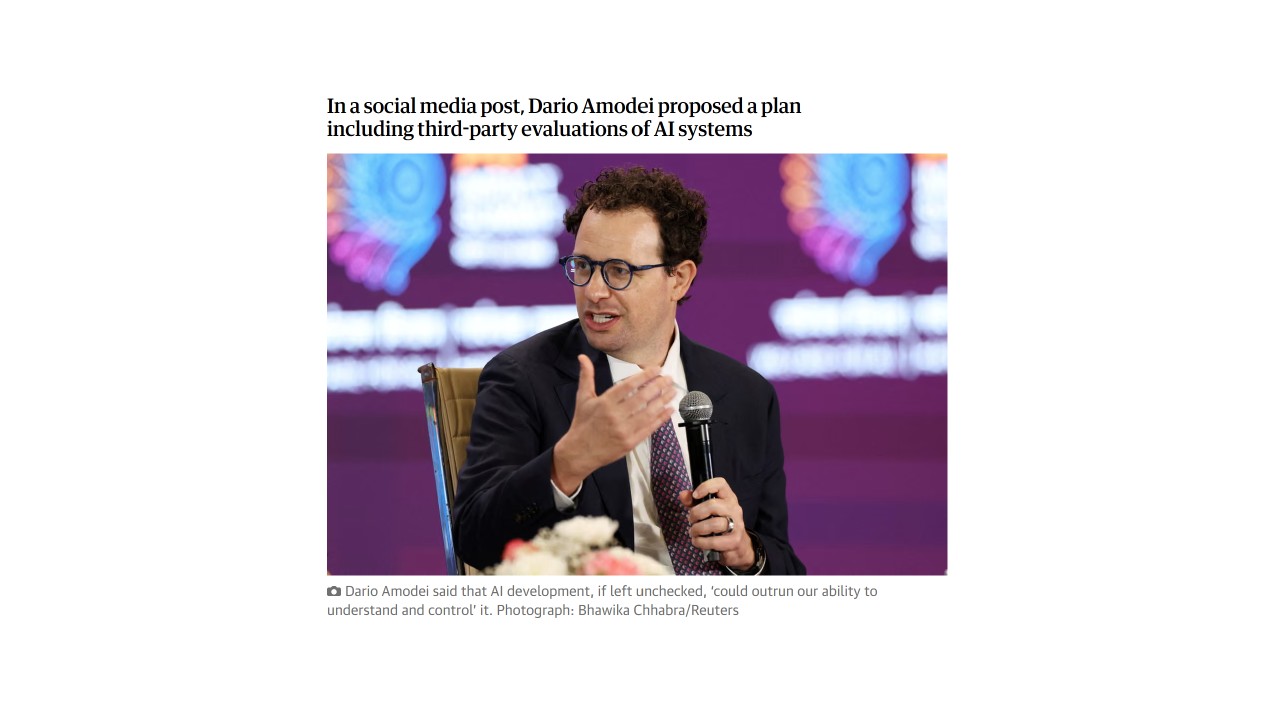
The calls this weekend to slow the development of frontier AI deserve to be taken seriously.
Dario Amodei is not a commentator watching the industry from the sidelines. He runs one of its most important companies. Sam Altman has publicly agreed with the principle of pacing the frontier and stronger independent evaluation. That makes this more than another debate about AI safety.
For companies that supply data to AI, there is an obvious question: if frontier development slows, does demand for training data slow with it?
In some areas, yes.
If fewer frontier models are trained, or training cycles become longer, demand for the enormous general-purpose datasets associated with those cycles could moderate. Any company whose economics depend entirely on frontier labs repeatedly buying ever larger quantities of training data should pay attention.
But that is not the entire data market anymore.
AI is moving from learning the internet to interacting with the world. Models are being asked to understand video, speech, physical environments, human actions and eventually operate through agents, robots and other machines. Those problems do not disappear because the next frontier model arrives six months later.
If anything, the constraint becomes more specific.
A model that already knows what a kitchen is does not need another million photographs labelled “kitchen”. A system expected to operate inside one needs to understand what people actually do there, in different homes, countries and cultures, and how objects, actions and environments relate over time.
That requires different data.
There is a second consequence. An industry asking for independent evaluation, alignment and greater accountability will eventually have to ask harder questions about the provenance of the data underneath its models. Amodei’s proposal explicitly moves the industry towards greater external scrutiny.
This is where our conviction around Clairva remains unchanged. We are not betting on AI companies needing infinitely more data.
We are betting on them becoming considerably more particular about which data they need, where it came from, what it teaches a model, and whether they have the right to use it.
A slower race may actually make that distinction clearer.
And that is probably the more important signal from this weekend.